By granting a bequest of a conservation easement to Guadalupr-Blanco River Trust landowners can ensure that their property will be managed according to their wishes well beyond his or her lifetime. A conservation easement permanently limits a property's uses in order to limit development and ensure that the property is reserved for farming, grazing land, wildlife habitat or cultural values. Landowners can stipulate no oil and gas development. Tax incentives may be available to landowners. It's worth giving a serious thought.
Helpful oil and gas leasing and farmout agreement information for Eagle Ford Shale landowners in the DeWitt and Gonzales County area. PROUDLY A LANDOWNER ADVOCACY BLOG: the only landowner advocacy blog on the internet. The Eagle Ford provoketh thieves sooner than gold.
Wednesday, August 29, 2012
Friday, August 24, 2012
DUG Eagle Ford
Last year I had the incredible good fortune to attend the DUG Eagle Ford conference in San Antonio and I heartily endorse, recommend and encourage all landowners who can to attend the conference this year. The direct benefits you will receive is a crash course education about what is going on in the Eagle Ford and Pearsall Shale. The speakers are highly regarded industry leaders that give you not only a review of where we are in the play but also an idea where Eagle Ford is heading. The exhibitor hall is immense, representing virtually all aspects of drilling and production technology and you get the opportunity to visit with them. The $895 investment you make to attend is a very small price to pay for the Eagle Ford education you will receive. If you own a Eagle Ford mineral interest you own something worth millions of dollars and you owe it to yourself and your family to attend DUG Eagle Ford.
Thousands have already registered;
Shouldn't your team get the same advantage?
Don't miss the world's biggest Eagle Ford conference Petroleum producers, midstream operators, finance and service professionals are converging in San Antonio this October for the 4th annual DUG Eagle Ford conference and exhibition. Shouldn’t you and your team be there to share the intelligence and make new business connections?An unparalleled slate of industry leaders is presenting and nearly 350 exhibitors are displaying their technologies. The biggest players on the scene, both upstream and midstream, will be attending. Once again, this event is the world’s largest Eagle Ford conference for the same reasons: It's the single best place to learn "what's next" for one of the most exciting regions in today's oil & gas business.
Featured speakers include: View full speaker line-up
EVP and COO Marathon Oil Corp. | President and COO Pioneer Natural Resources | President Swift Energy |
Speakers in the midstream program track — new for 2012 — will detail their plans for adding takeaway and treatment capacity. And one registration gives you access to both program tracks. Together, you get a full-spectrum perspective on where the opportunities lie ahead.
Go online to check the agenda and register today. Interested in bringing your entire team? Register 4 or more and receive $100 off each registration – just click the link when you register online.
Thursday, August 23, 2012
Drilling For Oil In The Unconventional Eagle Ford Shale
Drilling for crude oil in the
unconventional Eagle Ford shale is very much still in it's infancy. We are in the very early innings. The Eagle Ford has been know to be the
source for conventional natural gas and crude oil reserves in the
area for decades. Technology is improving at a very rapid pace and
horizontal drilling techniques continue to improve exponentially. Down spacing is occurring at 40 acres per well. EURs are going up substantially. Operators have rushed in to lease the best acreage in the six largest
shale basins that comprise 57 million acres. It's going to take a
very, very long time to develop all that acreage, perhaps a century
experts are saying.
Success in drilling in the Barnett,
Haynesville and Marcellus has caused the gas market to collapse.
Operators all want to drill on good oil prospects today like the
Eagle Ford volatile oil window. The oil window is where all the
action is today and that's where operators are allocating all of
their capital.
Little noticed in all that is going on
in the Eagle Ford is the way that it is shaping the future for the
petrochemical industry. Many large refineries and chemical plants are
being planned and announced for the Texas Gulf Coast. Pipelines are going in everywhere
along the entire length of the Eagle Ford. More pipelines are being
announced monthly.
The long and short of the Eagle Ford is that all liquids window acreage is extremely valuable. Mineral interest to all depths and horizons is incredibly valuable. Rosetta Resources claims EURs of 1.67 Million BOE per well at 55 acre spacing. At $100 oil the 1.67 million BOE per
well translates to $167,000,000 per 55 acres. If you owned 55 acres
and you receive 25% royalty that would amount to $41,750,000 due you
over the life of the well. With other horizons like the Austin Chalk,
Pearsall, Olmos and Buda you quickly see why Eagle Ford footprint
acreage is selling for well over $100,000 per acre.
Friday, August 10, 2012
Monster Wells Being Drilled Near Hochheim
Eagle Ford Hochheim Area "Monster" Wells
The CEO of EOG Resources recently made official what everyone already knows, that the over-pressure volatile oil window around Hochheim is far and away the most productive area of the Eagle Ford. One of the Boothe wells came in recently at 4,820 barrels of oil per day with 972 barrels of NGLs and 4.5 million cubic feet of natural gas per day. The conversion of NGLs and gas makes the well officially produce 6,642 barrels of oill equivalent per day. Not bad.
Operators in the volatile oil window along Gonzales/DeWitt counties are actively pursing a down spacing drilling program. Rosetta Resources is even experimenting with 55 acre wells. The Rosetta presentation below shows what looks to me like their best case expectation of 5 million barrels of oil per 195 acres. I did the math and it came out to 25,641 boe per acre if I divided correctly.
http://files.shareholder.com/downloads/ROSE/2013999911x0x573592/B24DD1DC-EEF6-4D42-8EA2-55083FA958EA/ROSE_2012_IR_Presentation_-_RBC-_FINAL-2012_0531.pdf
Friday, August 3, 2012
EOG Resources announces
“Monster” Eagle Ford Wells
Oil
& Condensate daily IP near 6,000 barrels per day + 4.5 Mmcfd
natural gas
During
the 2Q conference call on 8/03/2012 CEO Mark Papa announced that EOG
had drilled 16 “monster” wells in the Eastern portion of the
Eagle Ford near Hochheim.
“In
the South Texas Eagle Ford, EOG drilled its best well to date. The
Boothe Unit #10H in Gonzales County began
initial production at 4,820 barrels of oil per day (Bopd) while an
offset well, the Boothe Unit #9H, had an initial production rate of
3,708 Bopd. The Boothe wells produced 972 and 527 barrels per day
(Bpd) of natural gas liquids (NGLs) and 4.5 and 2.4 million cubic
feet per day (MMcfd) of associated natural gas production,
respectively. “
Thursday, June 14, 2012
Aurora Oil & Gas bullies Eureka Energy stockholders
Aurora Oil & Gas has made a hostile offer to buy all outstanding shares of Eureka Energy. The story is a simple case of greed as old as the hills, whereby Aurora seeks to muscle Eureka stockholders out of their rightful ownership of Karnes County acreage in the prolific oil window of the Eagle Ford. The Aurora Oil & Gas "BULLY" offer is available for viewing at:
http://www.auroraoag.com.au/irm/Company/ShowPage.aspx/PDFs/2073-75620328/EKAAuroraOfferPeriodAutomaticallyExtended
As proclaimed in the masthead of this blog, THE EAGLE FORD PROVOKETH THIEVES SOONER THAN GOLD
http://www.auroraoag.com.au/irm/Company/ShowPage.aspx/PDFs/2073-75620328/EKAAuroraOfferPeriodAutomaticallyExtended
As proclaimed in the masthead of this blog, THE EAGLE FORD PROVOKETH THIEVES SOONER THAN GOLD
Sunday, May 20, 2012
Option Value of Eagle Ford Acreage
May 20, 2012
Understanding The Option Value Of Eagle Ford Oil Window Acreage: Why Leaseholds Are Worth Over $100,000 Per Acre
Oil company leaseholds create instant value. By way of example, in the Eagle Ford Shale Chesapeake Energy was a late leasing entrant with their first leases acquired in November of 2009 and reached 300,000 net acres by March 2010, and later reached 625,000 net acres by October 2010 having invested $1.4 billion in leaseholds. Chesapeake later sold 200,000 net acres for $2.2 billion, leaving 425,000 net acres and 2.3 billion Boe possible to Chesapeake at a negative cost of $800 million. By obtaining cheap leasehold interest it created $7-10 billion.
Leasing (in fact a lease is a sale) is simply a very cheap way for oil companies to buy oil options for future production. Leasehold investments are no longer risky in the traditional sense as conventional oil and gas drilling were in the past. Today, shale oil and gas represent a very cheap option on a know resource. Using Chesapeake Energy provided disclosure, at $2,200 per acre (CHK cost), a Chesapeake Energy Eagle Ford acre overlays a minimum 5,000 bbls of recoverable oil. That's an option cost of =$.40/barrel plus $15.00 to develop it. Meanwhile, a financial option on oil (a call) sells for =$20.00/bbl (at strip prices covering 2015-18). McClendon asks if it is smarter to buy a call option on a barrel of oil at $20/bbl where the strike price =$90/bbl for an all-in cost of $110/bbl, or is it smarter to pay $.40/bbl and a $15/bbl "strike" price for an all-in cost of $15.40/bbl?
Chesapeake Energy brags their developments costs is $10-15/bbl which is effectively the strike price of this option
The CEO of Chesapeake Energy Aubrey McClendon famously asked the question "where else in the world, in any industry, cay you buy an asset for $1-1.5 billion and have it become worth >$5 billion within one year? Nowhere!" In no other industry are sheep led so willingly to the slaughter. Hydraulic fracturing along with a plethora of other new drilling and completion technology has changed the face of the oil and gas industry.
The Estimated Ultimate Recovery of all Eagle Ford Shale wells continues to go up substantially through down spacing, making it impossible to predict with any certainty how much above $100,000 per acre we will see. One thing is certain though, we are very early in the game and recovery factors are being improved by leaps and bounds.
From Aubrey McClendon's mouth to your ears:
Saturday, April 7, 2012
Royalty Sellers Succumb to JG Wentworth Ad Tactics
Landowners who sell their royalty interest today are doing so at a deep discount to the future value of their Eagle Ford production. Some landowners never even received anything like fair value for leasing their land for drilling rights to begin with. Now again today they are being approached by predators in what amounts to a double whammy and they are being conned out of their royalty income, selling it for pennies on the dollar.
Saturday, March 17, 2012
Oil & Gas Operators Took Advantage Of Eagle Ford Landowners
In case you haven't noticed it the price of crude oil has been on a tear lately, trading steady well above the $100 a barrel mark. That's both good news and bad news for Eagle Ford landowners. The good news is that when wells are produced landowners will receive nice royalty checks. The bad news is that the Eagle Ford Shale requires such intensive drilling on such tight spacing to extract all the oil in place that it will require many decades to drill and produce it all. Experts predict that it will take perhaps 40 to 50 years. A little know fact is that most oil and gas leases do NOT provide any shut in royalties or delay rentals for oil wells. With rare exception, "Delay Rentals" are for the most part reserved for gas wells only. Few in the oil industry talk about the fact that there are so many thousands of wells to be drilled that the majority of those wells won't be developed for decades into the future. Equally depressing from a landowners point of view is the fact that as the Eagle Ford is developed many wells will be shut in for ages due to lack of pipeline capacity. Despite the growing number of pipelines being constructed there will not be enough capacity to carry the vast quantities of Eagle Ford crude oil to refineries in quick order. There will be hundreds of thousands of acres simply held by production with very few wells drilled on many production units for the foreseeable future. There quite simply are over 30,000 additional Eagle Ford wells to be drilled and that will take many decades. This predicament will inevitably lead to the dilemma that many landowners, wishing to to monetize their acreage, will have to either sell their royalty interest at huge discounts to the vultures who trade in these financial transactions or see their future production go to their heirs. In any event, there is little chance that the majority of wells drilled to date, or that will be drilled in the near future, will be flowed and produced at capacity any time soon. The oil companies strategy is quite simply to use the enormous Eagle Ford reserves being developed as a hedge against currency debasement. If the experts are right and crude oil continues to rise, the Eagle Ford Shale will turn out to be the "steal of the century." The technology to exploit shale is relatively new. When it was developed and proved capable to crack the code of tight oil and gas shale’s that opened up enormous previously known areas with excellent source rock hydrocarbons. Like a thief in the night, big oil and gas operators moved into the Eagle Ford Shale and leased up acreage on the cheap. They knew it was rich in hydrocarbons and too big to be developed by a single company. They then set out to carve out their areas of interest and then proceeded to lease that acreage for practically nothing. Collectively they now own the premiere oil reserve in the US with the lowest finding and development cost. To deflect criticism that they took advantage of landowners, operators bemoan that there is much risk in developing a new play such as the Eagle Ford. That contention is just PR intended to hide the fact that they took advantage of landowners.
Monday, March 5, 2012
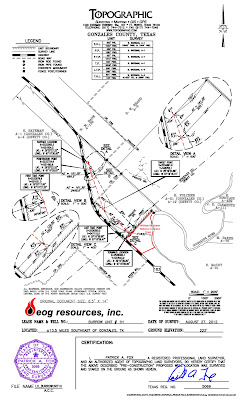
70.15 ACRES VOLATILE OIL WINDOW
Minerals No Longer Available
Accepting Offers For Surface Use Only
HIGH GRADE PREMIER EAGLE FORD TRACT
Eagle Ford Volatile Oil Window PUD Status Acreage
DeWitt County In The Heart Of The Best Acreage
contact owner Mike Green at 361-648-5800 email libertadormg@gmail.com
CONTACT OWNER MIKE GREEN 361 648 5800
There is extensive drilling being done in the immediate area and the 70.15 acres tract available is located right in the sweet spot middle of several drilling units in the area.
High Grade Area
The Meyer Unit is across the road on US 183 and Burrow B Unit next door from the subject property, indicating PUD status. This property is sandwiched between leased property nearby.
Irregular shape should allow for more lateral's
High Ground elevation in large flood plain. Potential drilling site above historic flood level of 1998
Major highway frontage on US 183
Meyer Unit across highway and Burrow B Unit on property line
Area is being rapidly developed with infill drilling
High ground on US 183
Sunday, February 26, 2012
Monday, February 13, 2012
Eagle Ford Pipelines Proliferate Scarring The Land
By far, the most common complaint I am hearing like a mantra from landowners is their concern about the heavy handed and unfair manner in which their Eagle Ford land is being confiscated for pipelines under the false flag and the guise of eminent domain. Eminent domain is a thin transparent disguise purporting public good to hide the virtual theft of private property. Pipelines exact a onerous and heavy burden on the land by reducing the actual overall value of a farm or ranch real estate value by as much half. In extreme cases it can reduce the value of property by more than half. The area near the pipeline cannot be built upon. In some cases, where pipelines run through the middle of a property, an entire ranch may be virtually reduced to nothing more than a stark reminder of the Houston Ship Channel. Those living near pipelines often suffer from PTSD like soldiers returning from war, with nervous and stress disorders from fears that a catastrophic leak may contaminate their land, or worse, a horrific fireball explosion. The original pipeline ROW is often the proverbial foot in the door that allows for additional pipelines and other utilities to be installed at later dates, usually into perpetuity. Some Eagle Ford landowners currently suffer from very wide main pipeline corridors running through their property containing as many as 6 or more large diameter pipelines in a single right-of-way. As the population grows by leaps and bounds as anticipated and more electric power has to be generated to meet the need, new high voltage main transmission power lines will be placed in these existing pipeline ROWs creating a visual blight on the land. There is a strong possibility that today's pipeline ROWs will in the future become the equivalent of the ill fated Trans Texas Corridor for every public utility imaginable. Even with the new-found riches of Eagle Ford oil and gas production, some landowners are finding that building a nice house in a bad neighborhood might not make sense today. Many landowners have already lost the beauty of their rural natural habitat to pipelines forever. Today they live and are required to adjust to having the perpetual ingress and egress intrusion of strangers on their land. It's a poor bargain no matter the price that is paid.
If you have a pipeline horror story I want to hear it. Please send me an email at libertadormg@gmail.com
A few pictures taken of pipeline activity around the Hochheim area on Saturday 2/11/2012
Tuesday, October 25, 2011
Advantages of Drilling Your Own Well
Oil and gas law in the State of Texas operates under the rule of capture as the fundamental law governing the rights of landowners owning petroleum in a common reservoir. It is settled law that landowners absolutely own all of the oil and gas in place under their land.
Farmout, Joint Venture, Working Interest Provides
Tax Benefits For Landowners
Direct participation in oil and gas development by either JV, joint operation, farmout, or having a working interest can generate several tax benefits for landowners. By deferring a large up-front bonus payment, common to a Paid Up oil and gas lease, in favor of direct participation, generous tax benefits can flow to landowners from directly participating in the drilling of a well. Some landowners find the large up front deductions for intangible drilling costs (IDC) and tax credits for the development of certain types of tight sands and shale formations to be more attractive. The IRS allows deductions for the cost of equipment and/or services used during the drilling, testing, fracking, and/or completion of the well.
Direct participation through Farmout, Joint Venture or other Working Interest in a well offers the following tax benefits.
Intangible Drilling Costs (IDC): The cost of drilling a well can usually be deducted immediately. The cost of labor, drilling rig time, drilling fluids, fracking services, etc. are intangible expenses deducted against the tax bill. Intangible drilling cost represent 60 to 80% of the total cost of the well. intangible Drilling costs is generally taken as a deduction in the tax year in which the intangible costs occurred.
Intangible Completion Costs: As with IDCs these costs are generally related to non salvageable completion costs, such as labor, completion materials, completion rig time, fluids etc. The deduction for intangible completion costs are usually about 15% of the cost and generally taken in the year they occur.
Depreciation: That part of the cost of the well associated with equipment, such as the well casing, Christmas tree, storage tanks, pumps, etc. are usually depreciated over a seven year period.
Depletion Allowance: Some say depletion allowance is the mother of all tax breaks. Once a well begins production, the IRS allows owners of the well to shelter some of the gross income derived from the sale of the oil and/or gas. Two types of depletion are available, cost and statutory (also referred to as percentage depletion). Cost depletion is calculated based upon the relationship between current production as a percentage of total recoverable reserves. Statutory or percentage depletion is subject to several qualifications and limitations. This deduction generally shelter's 15 per cent of the well’s annual production from income tax.
Tax Credits: The US Congress passed laws granting several tax credits to crude oil or natural gas production. Enhanced Oil Recovery legislation grants tax credits when applied to certain project costs incurred to enhance production from a oil or gas well. The credit can be 15% of the costs directly incurred to enhance production. Another generous credit is the Non Conventional Source Fuel Credit which provides for a $3 per barrel of oil equivalent credit for production from the so called qualified fuels. Qualified fuels include oil shale like the Eagle Ford, other tight formation gas, and fuels made from coal.
Lease Operating Expense: Day to day operational costs involved with the operation of a crude oil or natural gas well also offer tax deductions. The expense deduction also covers the costs of re-entry or re-work of an existing producing well. Lease operating expenses are generally deductible in the year incurred, without any AMT consequences.
Overview
It should be entirely obvious by now that the tax benefits of participating in a oil or gas well on your property generates substantial tax benefits. In a nutshell, oil and gas risk capital has the effect of being subsidized by the government resulting in greatly reduced federal income tax. Some people say that oil and gas exploration and production uniquely offers a bonanza of tax benefits not seen in any other business enterprise. Intangible drilling cost is very significant and by taking this deduction it mitigates greatly against the loss of any lease bonus money from a oil and gas lease agreement. I am not an accountant and I encourage everyone to consult with their own tax adviser in regards to the information provided herein.
Subscribe to:
Posts (Atom)